
Sattva Whitefield vs Sattva Varthur Road: Stress-Testing the Premium
You have shortlisted Sattva Whitefield: 25 acres in Bengaluru's most established eastern micro-market, roughly 2,000 apartments, a stated 70%-plus open-space share, ITPB 2–3 km away and a Purple Line metro station you can already ride. Then the same developer opens Expressions of Interest for a project down the Varthur–Sarjapur corridor at a visibly lighter ticket — and the obvious question lands: is the Whitefield premium earning its keep, or is Sattva Varthur Road quietly the smarter cheque?
This page stress-tests that premium line by line — connectivity, campus economics, unit design, delivery calendar and per-square-foot maths — using each project's own published numbers rather than broker gloss, and finishes with a decision matrix for both kinds of buyer.
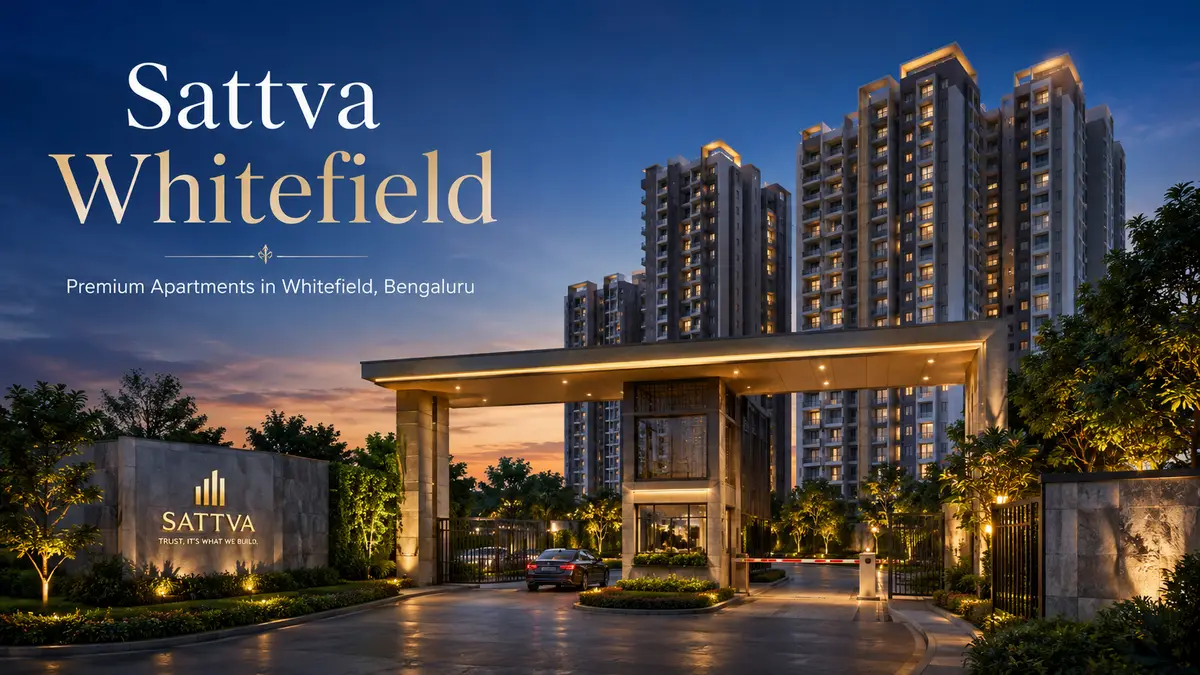
At a glance: Sattva Whitefield vs Sattva Varthur Road
| Factor | Sattva Whitefield | Sattva Varthur Road |
|---|---|---|
| Micro-market | Whitefield core (560066); ITPB 2–3 km, ORR 4–5 km | Dommasandra Circle, SH-35 Varthur–Sarjapur Road (560087) |
| Metro today | Purple Line operational — Whitefield (Kadugodi) station 3–4 km | None nearby; proposed Phase 3A Red Line, commissioning est. 2030–33 |
| Campus | 25 acres; 70%+ open and green space stated | ~16 acres; central clubhouse-anchored amenity deck |
| Scale | ~2,000 apartments; tower count not announced | 1,363 apartments; 8 towers of 3B + G + 33 |
| Density | ~80 units per acre | ~85 units per acre |
| Configurations | 2 BHK 1,100–1,300 sq ft; 3 BHK 1,500–1,800 sq ft (Vaastu-compliant) | Five variants, 1–4 BHK, 600–2,310 sq ft |
| Guidance rate | Estimated ₹11,000–13,500 per sq ft (pre-launch) | EOI ₹11,200 per sq ft; launch guidance ₹12,300 (Jul 2026, indicative) |
| Ticket band | ≈₹1.30–2.50 Cr (estimated) | ≈₹67 lakh–₹2.8 Cr (EOI-rate derived) |
| Possession | December 2029 estimated; phased 2028–2030 typical | March 2031 target; launch Q3 2026 |
| RERA | Registration awaited (pre-launch) | Not yet registered; BDA-approved layout |
| Airport | ~42 km to Kempegowda International | ~50 km (75–90 min via ORR–Hebbal) |
| Developer | Sattva Group — CRISIL AA/Stable; 142+ projects, 69M+ sq ft delivered | Same group; identical delivery record |
What the cheaper sibling actually offers
Before defending Whitefield, be precise about the challenger. Sattva Varthur Road is a ~16-acre, 1,363-apartment high-rise community — eight towers of three basements plus ground plus 33 floors — on the SH-35 frontage at Dommasandra Circle, behind Greenwood High School in south-east Bengaluru. It carries the corridor's widest configuration ladder, five variants from a 600 sq ft 1 BHK to a 2,310 sq ft 4 BHK with servant's room, on a BDA-approved layout, and it is not yet registered with K-RERA. The full scheme is set out on the Sattva Varthur Road overview.
Its pull is arithmetic. EOI-stage guidance recorded in July 2026 runs at ₹11,200 per sq ft with launch guidance of ₹12,300 — indicative until the official rate card — which prices its smallest home near ₹67 lakh, roughly ₹63 lakh under Whitefield's estimated ₹1.30 crore entry. For one segment of buyers, that single line ends the debate before it starts.
But entry price is where a comparison begins, not where it concludes. The two projects put you in different micro-markets, on different delivery calendars, with different unit menus and a very different relationship to Bengaluru's transit map. Each of those deserves its own test before you either bank the discount or pay Whitefield's premium. Note also what the challenger is not: as of late July 2026 it remains at Expression-of-Interest stage with pricing officially "on request", so its numbers are guidance recorded from the sales process, not a published cost sheet — and its formal launch is slated for Q3 2026.
Connectivity: a metro you can ride against a line on a map
Whitefield's defining asset in this matchup is boring and decisive: the Purple Line already runs. Whitefield (Kadugodi) station sits 3–4 km from Sattva Whitefield, putting Majestic, Indiranagar and MG Road about 45 minutes away by rail. Around it stands a mature district — ITPB 2–3 km, the Outer Ring Road 4–5 km, the airport roughly 42 km — plus the hospitals, schools and retail a two-decade-old IT hub accumulates as standard equipment.
Sattva Varthur Road's transit case rests on Metro Phase 3A, the proposed Hebbal–Sarjapur Red Line: 36.59 km, 28 stations, a revised DPR of ₹28,405 crore from October 2025 — still awaiting Union Cabinet approval, with construction likely through 2027–28 and commissioning phased between 2030 and 2033. Its road position is real, though: Wipro Kodathi about 5 km, the ORR at Bellandur about 10 km, ITPL about 12 km, all mapped on the Sattva Varthur Road location page. The airport is farther, at roughly 50 km — a 75–90 minute run.
Frame it as certainty versus option value. Whitefield's connectivity is fully built and fully usable on possession day in 2029. Varthur Road's rail upside, if the approvals land on schedule, arrives around its own March 2031 completion — a genuine catalyst, but one carrying a government-approval risk you do not control. A Whitefield buyer who commutes by rail, or wants tenants who do, is not being irrational in paying for the line that exists rather than the one on the map.
Campus economics: what 25 acres buys over 16
The acreage gap is the premium's first pillar. At 25 acres, Sattva Whitefield is buying land depth that lets ~2,000 homes coexist with a stated 70%-plus open and green share and a 20,000-plus sq ft clubhouse — the campus-style format that is hard to assemble at this scale in a built-out micro-market, and the reason large parcels historically hold resale and rental interest in the eastern belt. Density works out to roughly 80 units per acre.
Sattva Varthur Road answers with verticality rather than spread: 1,363 homes on ~16 acres — about 85 units per acre — stacked into eight 33-floor towers over three full basement parking levels, which clears the ground plane for a clubhouse-anchored amenity deck and a single central green. Its published amenity list is long and specific: squash and tennis courts, spa, steam and sauna, creche, co-working lounge, mini theatre, amphitheatre, pet park, reflexology path, STP-recycled water, solar common-area lighting and EV charging.
Two fair observations cut against a reflexive "bigger is better". First, the density difference is modest — about five units an acre — so the lived difference will come from tower spacing and podium design, and Whitefield has not yet announced its tower count or floor heights, leaving that part of the claim unverifiable until the masterplan releases. Second, Varthur Road's fully-basemented parking is already specified, while Whitefield's parking architecture is not. The premium buyer is paying partly for land that is banked and visible, and partly for masterplan detail still to be published. Hold both halves of that honestly.
Unit design: two disciplined formats against the full ladder
Sattva Whitefield's menu is deliberately tight: Vaastu-compliant 2 BHKs of 1,100–1,300 sq ft (carpet 770–910) and 3 BHKs of 1,500–1,800 sq ft (carpet 1,050–1,260), estimated at ₹1.30–1.75 crore and ₹1.80–2.50 crore respectively. A narrow band curates the resident profile — family end-users, limited investor churn — and simplifies eventual resale because every exit has dozens of near-identical comparables inside the same campus.
Sattva Varthur Road spreads five formats across the demand curve: a 600 sq ft 1 BHK, 1,080–1,210 sq ft 2 BHKs, a two-toilet 3 BHK at 1,310–1,420 sq ft, a three-toilet 3 BHK at 1,532–1,800 sq ft, and 4 BHK-plus-servant homes of 2,040–2,310 sq ft — all detailed on the Sattva Varthur Road floor plans page. The ladder maximises addressable buyers: entry investors at ₹67-odd lakh, upgraders through the middle, and large-format families above 2,000 sq ft — the first and last being categories Whitefield simply does not serve.
Stress-test your own requirement against both menus. If you need a 4 BHK, a servant's room, or a sub-₹1-crore ticket, Whitefield is out on specification alone and the premium debate is moot. If you are a 2 or 3 BHK family buyer — the overwhelming middle of this market — both projects serve you, and Whitefield's carpet areas are already published while Varthur Road's carpet figures await its launch sheet. Weigh, too, what a 600 sq ft investor tier does to a tower's long-run tenancy mix if a homogeneous owner-occupier community matters to you.
The calendar: December 2029 against March 2031
Sattva Whitefield's estimated possession is December 2029, with phased delivery across 2028–2030 the realistic pattern for a ~2,000-unit campus. Sattva Varthur Road launches in Q3 2026 and targets March 2031 completion. The gap is about fifteen months — and it compounds in Whitefield's favour three separate ways.
- Rent avoided. An end-user paying eastern-belt rents through 2030 and into 2031 hands back a meaningful slice of Varthur Road's ticket discount before the keys ever arrive.
- Income started. A landlord at Whitefield can be collecting rent in a sub-5%-vacancy market a year-plus before the Varthur Road unit is habitable.
- Risk window shortened. Every quarter between booking and registration-backed delivery is exposure; a shorter build calendar is structurally less of it.
The caveat applies symmetrically: both dates are estimates from pre-RERA projects, and neither is contractual until its registration is issued. Sattva's recent cadence of securing registration essentially at launch suggests neither buyer waits long once launch windows open — Varthur Road currently gathers Expressions of Interest ahead of its Q3 2026 launch, while Whitefield's registration is expected at or before its own formal launch. Treat the fifteen-month spread as the working assumption, and re-run this arithmetic the day either K-RERA certificate publishes a binding completion date, because that document — not marketing collateral — is what a delay claim would stand on.
Running the rupees: is the Varthur Road discount real?
Strip the tickets back to rate and the discount narrows sharply. Sattva Varthur Road's EOI guidance of ₹11,200 per sq ft, with launch guidance at ₹12,300, sits almost entirely inside Sattva Whitefield's estimated ₹11,000–13,500 band. On like-for-like area, a 1,500 sq ft 3 BHK prices in the same ₹1.7–1.9 crore neighbourhood at either project at mid-band rates. The configuration-by-configuration arithmetic is on the Sattva Varthur Road price page — worth reading beside Whitefield's own estimates before assuming a bargain exists in the shared formats.
The corridor context does favour the challenger's momentum. Varthur Road flats average about ₹10,900 per sq ft with an 81.7% three-year climb and 175.9% over ten years; the Sarjapur Road core averaged about ₹12,000 in Q1 2026, up 15.7% in a year. Dommasandra remains one of that corridor's entry-price pockets. Whitefield's counter is maturity: values up roughly 35% over five years with vacancy under 5% — slower percentage growth from a higher, deeper, more liquid base.
So the honest answer: the discount is real only at the ends of the ladder — the ₹67 lakh 1 BHK and the ~₹2.8 crore 4 BHK, formats Whitefield does not sell. In the shared 2–3 BHK middle, you are not buying the same thing cheaper; you are choosing between an established micro-market with running infrastructure and an emerging node with steeper trend lines and a metro promise dated 2030–2033. Price that choice on your own commute and horizon, not on the brochure gap.
Decision matrix: hold Whitefield or switch
Hold Sattva Whitefield if:
- Your workplace or tenant pool is ITPB/Whitefield-centred, or your household needs the operational Purple Line rather than a proposed 2030s alignment.
- Keys by end-2029 matter — you are renting now, or want rental income flowing before 2031 in a market with sub-5% vacancy.
- You want a curated 2–3 BHK family campus with a stated 70%-plus open-space commitment on 25 banked acres.
Switch to Sattva Varthur Road if:
- Your budget is under ₹1 crore — its 600 sq ft 1 BHK is the only door in this pair — or you need a 4 BHK with servant's room, which Whitefield does not offer at any price.
- You commute toward Sarjapur, Kodathi or the ORR's southern arc, where Dommasandra is the nearer address by several kilometres.
- You are an appreciation-first investor comfortable holding to 2031-plus, positioned for the corridor's trend lines and the Phase 3A catalyst — start with the Sattva Varthur Road project overview and its EOI terms.
Whichever way this lands, the closing discipline is identical on both sides of the corridor: neither project holds a K-RERA registration as of July 2026. Whitefield's is awaited ahead of launch; Varthur Road is not yet registered either, on a BDA-approved layout. Book against a verified registration on rera.karnataka.gov.in — the campus, the metro and the discount all rank second to that document.
Comparing Sattva Whitefield and Sattva Varthur Road? Talk to us.
Our team can share dated cost sheets, current offers and a side-by-side breakdown for both projects so you can decide with real numbers. Most responses arrive within the hour during business hours.
Talk to a Sales ConsultantSattva Whitefield vs Sattva Varthur Road - Frequently Asked Questions
Is Sattva Whitefield more expensive than Sattva Varthur Road?
At ticket level, yes — Sattva Whitefield starts around an estimated ₹1.30 crore for a 2 BHK, while Sattva Varthur Road's 600 sq ft 1 BHK computes to roughly ₹67 lakh at EOI-stage rates. On a per-square-foot basis the gap largely closes: an estimated ₹11,000–13,500 at Whitefield versus ₹11,200–12,300 guidance at Varthur Road. Both projects await official launch price sheets.
Which is closer to a working metro station, Sattva Whitefield or Sattva Varthur Road?
Sattva Whitefield — the operational Whitefield (Kadugodi) Purple Line station is 3–4 km away, about 45 minutes by rail to Majestic. Sattva Varthur Road has no operational metro nearby; its rail case rests on the proposed Phase 3A Hebbal–Sarjapur line, which still awaits Union Cabinet approval, with commissioning estimated between 2030 and 2033.
Which project is bigger, Sattva Whitefield or Sattva Varthur Road?
By land, Sattva Whitefield — 25 acres against approximately 16. By announced homes, also Whitefield: ~2,000 apartments versus 1,363. Density is similar though: roughly 80 units per acre at Whitefield against about 85 at Varthur Road, which reaches its count through eight 33-floor towers, while Whitefield's tower configuration has not yet been announced.
Should I buy a 3 BHK at Sattva Whitefield or Sattva Varthur Road?
Both serve 3 BHK buyers. Whitefield offers 1,500–1,800 sq ft (carpet 1,050–1,260) at an estimated ₹1.80–2.50 crore in the established, metro-served micro-market. Varthur Road offers two variants — two-toilet 1,310–1,420 sq ft and three-toilet 1,532–1,800 sq ft — from roughly ₹1.47 crore at EOI-stage rates. Decide on commute geography and delivery: December 2029 estimated versus March 2031 targeted.
Do Sattva Whitefield and Sattva Varthur Road have RERA numbers yet?
No — as of July 2026 neither project is K-RERA registered. Sattva Whitefield's registration is awaited ahead of its formal launch; Sattva Varthur Road is not yet registered either, on a BDA-approved layout. Verify any number directly on rera.karnataka.gov.in before booking either project, and disregard RERA IDs circulating on aggregator pages in the meantime.
Which delivers first, Sattva Whitefield or Sattva Varthur Road?
Sattva Whitefield, on current estimates: December 2029 possession, with phased handover across 2028–2030 typical at its ~2,000-unit scale. Sattva Varthur Road targets March 2031 completion after a Q3 2026 launch — roughly fifteen months later. Both timelines are pre-registration estimates; binding completion dates arrive only with each project's K-RERA certificate and agreement of sale.